 Paso FusionTalk to us
S2 · SELF-HOSTED MODELS · GPU CLOUD
Self-Hosted Open-Weight Model Solutions
Coordinating multi-cloud GPU infrastructure to optimize memory allocation, parallel execution, and runtime stability tailored to the distinct computing profiles of large language models and video generation systems.
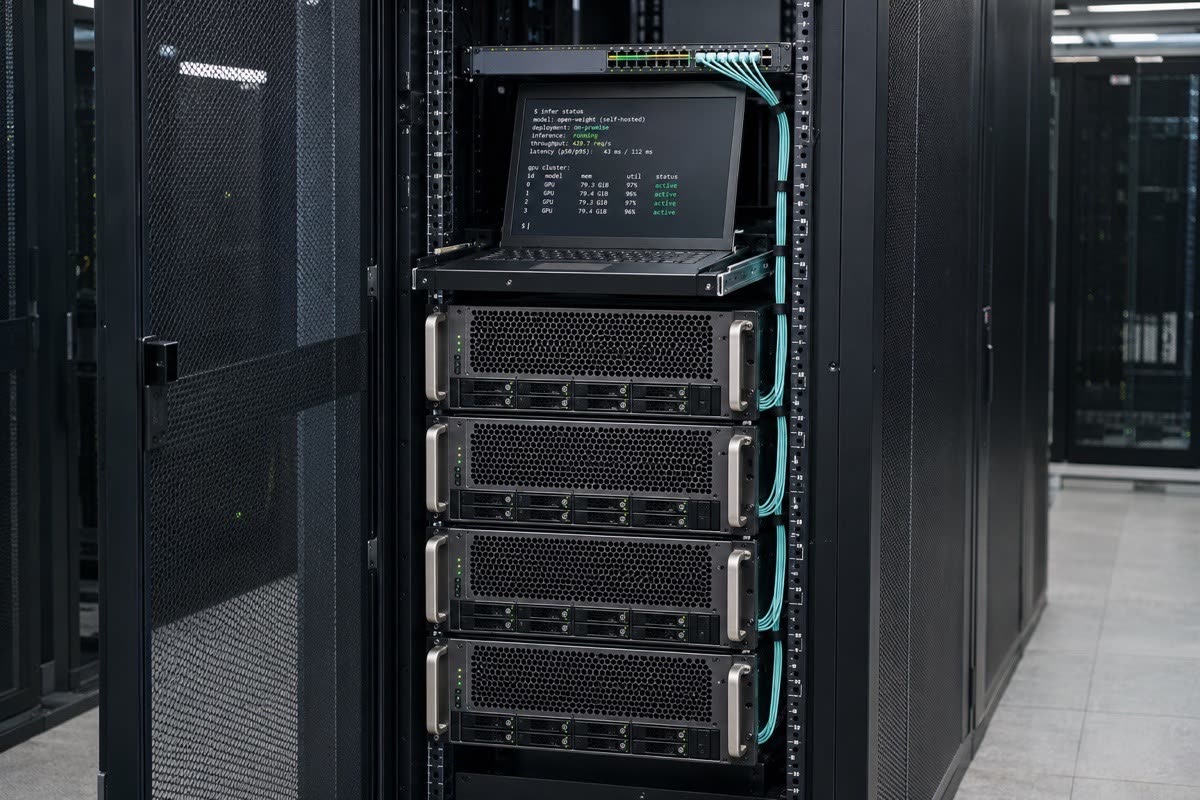
Deployment Profiles for Language and Video Generation Models
Self-hosting open-weight models demands careful balancing between neural network architectures and production request patterns. Large language models are heavily constrained by context length, KV cache footprints, dynamic batch concurrency, time-to-first-token (TTFT), and per-token generation latency.
Video generation models (such as MiniMax H3) demonstrate heightened sensitivity to frame resolution, frame rates, total video duration, and single-pass inference compute time, displaying peak VRAM profiles and task-exclusive execution windows fundamentally different from text generation.
Open weights do not inherently imply unrestricted open-source rights. Project initiation includes rigorous verification of upstream licensor commercial terms, derivative work stipulations, and hosting limitations.
GPU Memory, Precision, and Parallelism Configurations
Model parameter weights, transient activation states, and runtime KV caches define the per-instance GPU memory ceiling. Adopting FP16, BF16, FP8, or lower-bit quantization requires balanced evaluation across architectural compatibility, inference engine kernel support, and downstream output fidelity.
When single-card GPU memory is insufficient or single-machine throughput is constrained, tensor parallelism, pipeline parallelism, sequence parallelism, or memory offloading strategies should be evaluated based on model characteristics and underlying hardware interconnect capabilities, avoiding applying a single configuration disconnected from actual model and engine conditions.
Inference Engines, Weight Loading, and Runtime Validation
Different inference frameworks have different focuses in operator optimization, continuous batching, prefix caching, and multimodal pipeline support; engineering teams select suitable runtime environments based on the target model version.
Within defined test scopes and available pilot environments, empirical benchmarks measure container build pipelines, weight loading times, sustained throughput, tail latency distributions, and operational stability across realistic context lengths and concurrency levels.
Multi-Node Topology and Multi-Region Deployment
When model dimensions exceed single-server capacities or applications serve users across Southeast Asia and adjacent regions, high-speed intra-node fabrics, cross-node network bandwidth, and weight distribution channels require coordinated engineering.
Multi-region deployments combine upstream cloud platform resource availability across Singapore, other nodes in Southeast Asia, Australia, and other locations to arrange primary and standby replicas, traffic ingress, and cross-region data synchronization plans.
Scope of Deliverables and Operational Boundaries
Project deliverables include hardware and parallelism configuration lists, inference container and parameter configuration notes, validation reports, and go-live cutover recommendations; underlying GPU instances and datacenter facilities are provided by upstream cloud providers, with Paso Fusion responsible for solution design, resource coordination, and engineering technical support within the agreed scope.
Prepare deployment inputs
Scope, evidence and responsibilities are confirmed for each project.
| Input | Information to prepare | Assessment focus |
|---|---|---|
| Weights | Version, format and licence | Engine compatibility and usage scope |
| Output specification | Context distribution or video generation settings | Memory peaks and execution time |
| Traffic | Concurrency, batching and queue priorities | Replica planning and scheduling constraints |
| Memory budget | Precision, cache and activation requirements | Parallelism and offload options |
| Interconnect | Host and node communication needs | Measured communication baseline |
| Storage and delivery | Weight distribution and output destinations | Transfer cost and access responsibility |